When Alan Milburn’s interim report singled out supported internships as good practice, it described something we have been running in Tower Hamlets since 2019. Seven years in, 68% of our graduates have moved into paid work. This is what made that possible, what still gets in the way, and what we built when the standard model turned out to be too big a first step.
Seven years, 54 young people
Phoenix College has delivered DFN Project SEARCH in Tower Hamlets since 2019. Between then and 2025, 54 young people joined the programme and 52 completed it. Thirty-six moved into paid employment, and 34 are still working.
That is a 68% employment outcome rate, against a DFN Project SEARCH national average of 65%. It matters because of what sits underneath it. Department for Education puts the national supported internship figure at 48%, while for some groups of young people with SEND, as few as 5% move into permanent jobs at all. The 94% sustainability rate is the number we are proudest of: getting someone hired is a milestone, but keeping them in work is the point.
None of this is charity hiring. Every one of those 36 jobs exists because an employer decided the young person in front of them could do the work.
The partnership is the programme
Supported internships do not run on goodwill alone. Ours works because several organisations have each carried a share of it for years.
Queen Mary University of London took our first four interns in 2019 and is still with us seven years later. A Facilities Management Company, within a Corporate bank, opened a second site in 2023, a Global Law Firm a third in 2024, and Amazon a fourth in 2025. London Borough of Tower Hamlets has backed the programme throughout, Kaleidoscope, along with Phoenix College have continually provided specialised site leads and job coaches, while DFN Project SEARCH provides the model, the licence and a national network that stops any single site working in isolation.
Then there are the employers who actually hired: Greggs, Leon, Jubilee Street Practice (NHS), JPC by SAMSIC, Sharpsmart and others. One Greggs manager told us she had never considered employing an autistic person before we approached her, not out of prejudice but because she simply would not have known how. She interviewed anyway. Four years on, that intern is still on her team.
That is the pattern worth noticing. Most employers are not hostile. They are unpractised. The job of a supported internship provider is to close that gap, and in 2023 the British Association for Supported Employment recognised our team’s work on exactly that with its Practitioner of the Year award.
The interns did the hard part
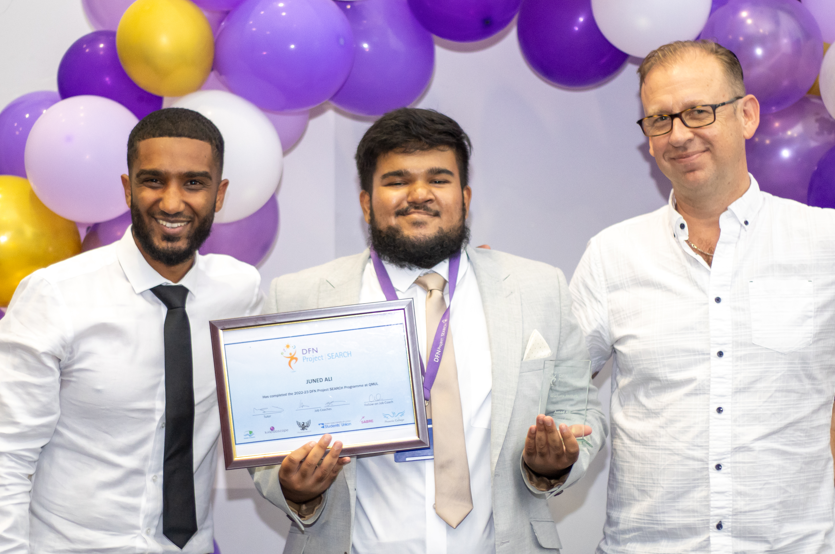
Juned joined us at 18 with his heart set on administration. His three-month placement at a GP practice became a permanent job, and he is still there three years later. The practice’s chief operating officer now describes him as one of the most forward-thinking members of staff they have.
Abeeda arrived curious about everything and found her direction halfway through the year, in hospitality. Her first ever job interview was with Greggs. She got it, and she has been there four years.
Hasan came back to us after a year at college that had not worked out. His team at Queen Mary were impressed enough that they built an apprenticeship around the work he had been doing. He has since passed his driving test, handled some difficult personal circumstances with the right services alongside him, and built a life that holds together.
I mention them because the national conversation about NEET young people tends to talk about cohorts and costs. Milburn’s interim report found that 84% of NEET young people want work or training. That has been true of every intern we have taught.
Three things still get in the way
Access to Work is not accessible enough. The scheme is meant to be the mechanism that makes employment viable for a disabled person, and in principle it is the right one. In practice it is difficult to navigate, slow to resolve and hard to explain to an employer who is deciding whether to make an offer. We spend time on it that should be going into job coaching. If the Government wants more disabled young people in work, the route to in-work support has to be quicker and far easier to understand than it currently is.
Entry-level roles are disappearing. Milburn’s interim report describes the first rung of the career ladder thinning, with recruitment increasingly remote and automated. We feel that directly. The roles our interns are ready for, the structured, practical, in-person jobs that let someone prove themselves, are exactly the ones being cut, consolidated or screened out by online application systems that filter a candidate before any human has met them.
Families are understandably cautious about benefits. Parents who have spent years securing support for their child are being asked to accept a change that might put that support at risk. That is not irrationality, it is risk management by people who have had to fight for everything. We work through the detail with families, benefits calculations included, so the decision is an informed one rather than a leap. But a welfare system where moving into work feels like a gamble will keep producing hesitancy, however good the programme.
Why we built a shorter bridge
A supported internship is five days a week in a working environment. For most of our interns that intensity is the thing that makes it work. For a young person who has been out of education and work for a year or more, it can be the thing that makes it impossible. We were turning away, or losing early, exactly the young people the NEET figures are about.
So in 2026 we launched a Pre-Supported Internship at Queen Mary University of London. It is phased rather than full-time: time to build travel confidence and independence, to get used to workplace routines and expectations, and to be around colleagues before being asked to hold down a full timetable. The point is not a lower expectation. It is better preparation, so that when a young person starts the full programme they start it ready.
This is what re-engagement actually looks like on the ground. Not a scheme that assumes someone can go from nothing to five days, but a bridge with a first step low enough to reach.
Scaling takes more than a recommendation
Milburn’s interim report called this a failure across the whole system, spanning health, education and welfare, and found that young people with SEND are around 80% more likely to be NEET. His final report is published this week, and expansion of supported internships is widely expected to feature in it.
If it does, the sector should welcome it, and then be honest about what expansion requires. More places need more host businesses willing to commit for a year, more job coaches trained to a standard that holds, an Access to Work system that moves at the speed employers hire at, and enough entry-level roles to move people into at the end. A target without that infrastructure produces programmes that run but do not place.
We have spent seven years building the thing Milburn is describing, on a modest scale, in one London borough. It works. Fifty-two young people have graduated, 36 are in work and 34 have stayed there. The model is not the hard part. The conditions around it are.