Good morning. Over the summer, doctors in the emergency department at the North Devon district hospital in Barnstaple, one of the most remote in the UK, received a crash course on delivering a baby. Their training covered subjects nobody wants to hear about when they're imminently expecting: shoulder dystocia, postpartum haemorrhage, and neonatal collapse. "I'm hoping that we won't see such emergencies," one doctor said. "It's been an intense time."
That crash course was necessary because maternity services at the hospital have been indefinitely suspended due to staff shortages. Other remote hospitals across the country are expected to do the same, as NHS trusts struggle to recruit enough staff to safely deliver babies. Earlier this week, the Guardian reported that up to 20 maternity units in England could shut. The story sheds light on a maternity care crisis that has been rumbling on for years, and shows how childbirth has changed dramatically over the last decade.
The Guardian's health policy editor, has been reporting on this story, and has covered nearly every major maternity scandal in the health service's recent history. In today's newsletter, he reveals the alarming stakes involved in this one. First, here are the headlines.
Five big stories
In depth: 'If you don't have enough doctors, you can't run a service safely'
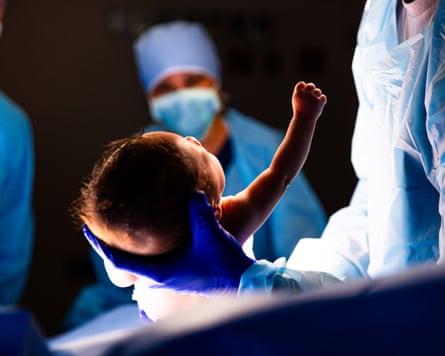
Matthew Hopkins, NHS Alliance's lead director of acute care, recently suggested to Denis that up to 20 of the UK's 155 NHS maternity units could be at risk of closure. Two units, the one in Barnstaple and another in Yeovil, Somerset, have already suspended maternity services because of staffing shortages, while a hospital in Newry, Northern Ireland, plans to permanently shut down its maternity services.
One reason for these potential closures is that people are having fewer children. The Royal Free hospital in North London recently announced that it was permanently closing its maternity unit because the number of women having babies locally has fallen by almost 30% in the last seven years (four of the area's primary schools have shuttered during the same period). But the main concern for many units at smaller hospitals in rural and coastal areas is staffing. These are often areas without alternative provision nearby.
At the same time, childbirth has changed. More women than ever are now getting C-sections or having births that require medical intervention from doctors, and smaller maternity units are also grappling with a widespread lack of obstetricians. "If you don't have enough doctors, you can't run a service safely, so more and more smaller hospitals are considering losing their maternity units altogether," Denis says.
Why are more women having C-sections?
The rapid growth of caesareans, both planned and emergency, appears to be one of the primary reasons that some smaller hospitals are considering suspending maternity services. The proportion of births performed by caesarean increased from 31% in 2019 to 45% in 2024, and last year was the first time in England that more babies were born via c-section than "natural" births (a term that many women find pretty grating because it implies there's a hierarchy between births with medical intervention and those without).
"England's rate of caesareans is unusually high compared to similar European countries, and all of the experts I speak with think this is just going to keep going up and up," Denis says. This dramatic rise in caesareans has several causesincluding changes in clinical practice designed to reduce the risk to babies and (quite rightly) give women more choice over how they give birth, as well as an increase in pregnancies among women who are over the age of 35 (the average age of parents in England and Wales has been increasing steadily for the last 50 years).
But this isn't the whole story. Some women are also worried about the type of care they might receive during vaginal births. Successive reviews portray a state of crisis, with burnt-out and exhausted midwives, a growing risk of serious injuries, and women of colour experiencing persistent racism and discrimination. A national review of maternity services in England from 2022 to 2024 by the Care Quality Commission warned that serious harm in maternity care risked becoming the norm.
"There's real concern among maternity doctors that women are reading endlessly negative headlines about the poor quality of NHS maternity care, which is leading them to ask for C-sections," Denis says.
As the rate of caesareans increases, trainee midwives are struggling to gain the experience of dealing with more complex births, potentially creating a cycle in which more women end up having caesareans. "Rather than building huge obstetric units and planning for a far higher caesarean rate, which is where we're currently heading, the NHS should be investing in community-based and continuous midwifery care, alongside excellent obstetric care for women who need it," Debbie Garrod, a midwife and antenatal educator, tells me.
How is the fear of medical negligence claims affecting childbirth?
Another reason for this rising rate of caesareans is something known as "defensive practice". This is when doctors, nurses and midwives make decisions to avoid blame or complaints, rather than because those decisions are necessarily in a patient's best interests.
The cost of settling all outstanding maternity-related claims in England was estimated at £37.5bn last year, nearly two-thirds of the NHS's total £60bn clinical negligence liabilities bill. It's a figure that senior MPs have described as "jaw-dropping". In fact, the bill for maternity negligence claims in England since 2019 could be more than the health service's budget for newborns during the same period.
"If a baby ends up suffering a catastrophic injury because it was deprived of oxygen for a few minutes during birth, that can cost the NHS £20-30m," Denis says. "Doctors are so aware of these risks, and of being pilloried with scandals and inquiries, that they often try to take a no-risk approach to childbirth."
?
There have been four inquiries into maternity scandals in England since 2015, one national maternity review led by Valerie Amos, and a further two inquiries led by Donna Ockenden, which are now ongoing. Denis estimates these have made no fewer than 700 recommendations for improving maternity services. "Experience shows that many of these have gathered dust on a shelf, and by almost every metric, maternity care has got worse, not better," he says.
By all accounts, this shouldn't be happening. The number of births has decreased significantly since the first of these inquiries was published in 2015, while the number of staff in maternity units has increased. So why is maternity care getting worse? "That's the big question," Denis says. "You could give about 65 different answers." So I pressed him on the most important ones.
Childbirth, he says, has become more complicated, as the NHS has attempted to reduce its risks through measures such as early inductions and increased monitoring. As the population has become less healthy, more women also now have underlying health issues such as diabetes and obesity. Meanwhile, women from poorer backgrounds, and Black and Asian women, continue to experience the worst maternal outcomes, as the Amos review demonstrated.
The government's maternity and neonatal taskforce is expected to publish an action plan before Christmas, building on the recommendations from the Amos review. "There is great scepticism among maternity doctors about this plan, given how little has changed after previous reviews," Denis says. "I think it's going to need the best luck in the world to address this sense of fear and failure."
What else we've been enjoying

| Michael Carrick's future as Manchester United manager is in the balance after a humiliating 4-1 Champions League defeat by Como on Wednesday night.
| Declan Rice's late equaliser rescued a 2-2 draw for Arsenal in a blockbuster contest at Bayern Munich after Harry Kane had scored from the spot.
| Jimmy Anderson is expected to call time on his remarkable career at the age of 44 after being told his contract at Lancashire will not be renewed for next season.
The front pages
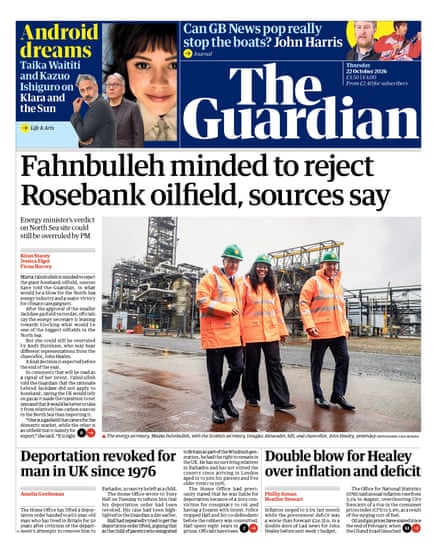
"Fahnbulleh minded to reject Rosebank oilfield, sources say", is the 's splash today. The 's take is "Pathetic", and writes "Drill, Andy, Drill!".
The has "Putin's trawlers spy on Britain", and the writes "'To deter war Britain must be ready'". The leads with "Schools face cutting SEND staff to fund 2026 pay rise for teachers", and the has "Chancellor: I'll cut cost of business to boost UK". The says "Musk's vision for SpaceX and Tesla combination welcomed by investors".
The splashes "Kyle inks it's all over" and the , on Prince Harry and William's rift, has "Ruled out".

'Disgraceful': Jackdaw gasfield approval condemned
Climate campaigners have condemned the UK government's decision to allow the drilling of the Jackdaw gasfield. Critics argue the move will put climate targets at risk, while failing to reduce energy bills and the cost of living crisis. But there could be a significant victory for green activists when it comes to the much larger Rosebank oilfield, with the energy secretary, Miatta Fahnbulleh, leaning towards rejecting approval. Michael Safi speaks to environment correspondent Matthew Taylor.
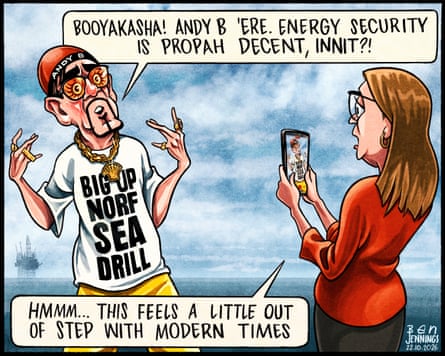
Cartoon of the day | Ben Jennings
A bit of good news to remind you that the world's not all bad

Finally, Lake Windermere might be clean again. After years of being pumped with sewage, a creative solution to remove sewage from England's largest lake has been agreed by campaigners, the Environment Agency and a local water company. Inspired by the clean-up of Lake Annecy in France, the plan proposes a 12 mile tunnel that will take treated effluent from Windermere to the River Leven or the sea.
Sign up here for a weekly roundup of The Upside, sent to you every Sunday
Bored at work?
And finally, the Guardian's puzzles are here to keep you entertained throughout the day. Until tomorrow.